Choosing, paying for and installing grave monuments in Toronto and Ontario cemeteries, including operator bylaws, licensing and inscription decisions
Buried in November, stone up in September. What happens in the ten months between
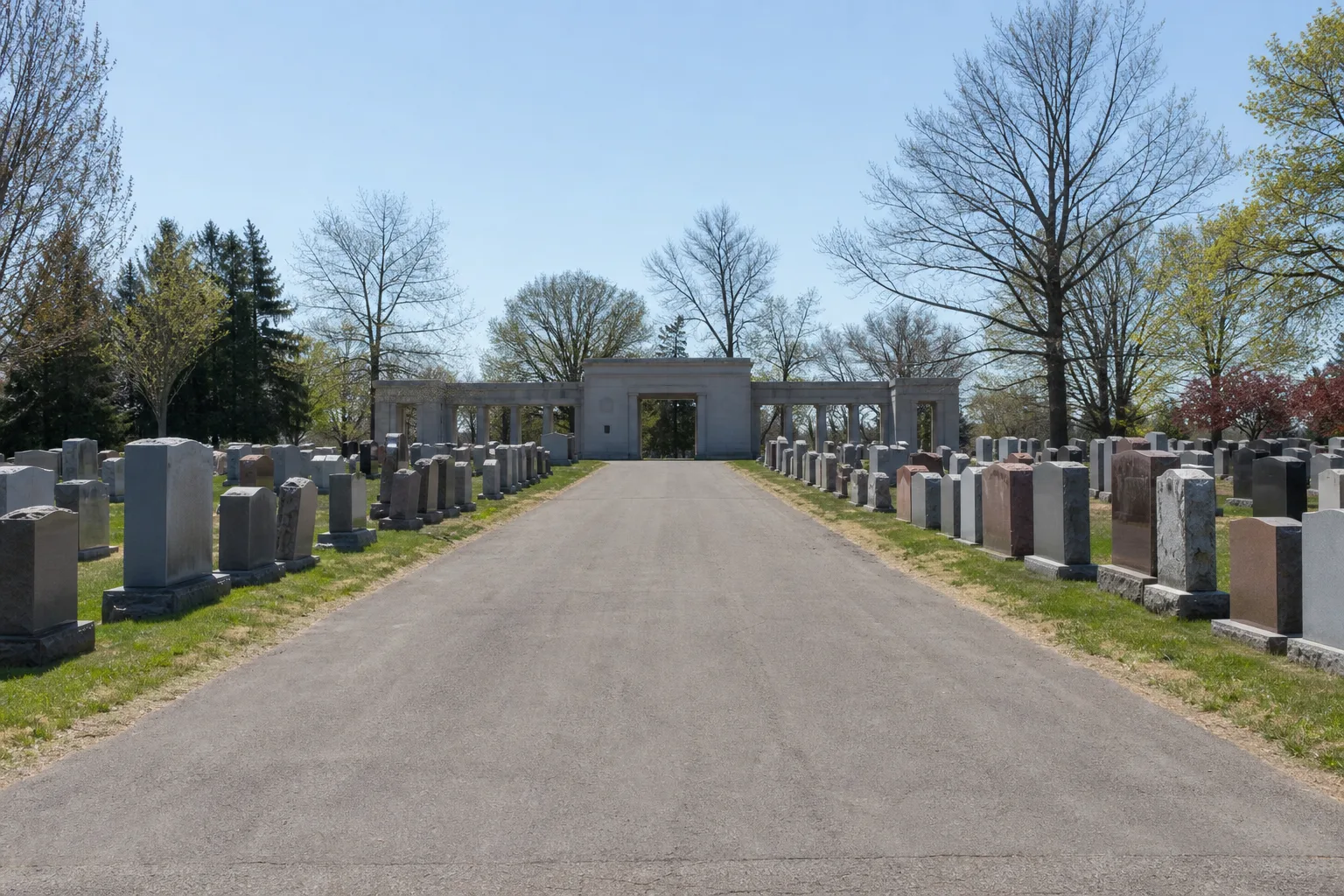
One freeze and thaw. Most operators want the backfilled grave to go through a full winter before a foundation is poured on it. Loose soil consolidates unevenly, and a stone set too early can tilt within a year.
Approval comes before cutting. The cemetery stamps a scaled drawing showing height, base footprint, setback and the complete inscription layout. Granite is not cut until that approval comes back.
Sections have different rules. A single cemetery can permit upright monuments in one section and flat bronze or granite markers only in another. The bylaw governs the section, not the cemetery as a whole.
A family buries a parent in a Toronto cemetery in late November, chooses a granite marker three weeks later, pays a deposit before the end of the year, and then waits. The stone goes up the following September. Nobody misled them and nothing went wrong; the sequence simply has more stages in it than most people expect, and several of those stages are governed by weather and by the cemetery operator rather than by the dealer taking the order. Understanding where the months go is the difference between an anxious spring and a planned one.
The rights holder signs, not the next of kin
Before a monument can be discussed at all, the cemetery has to know who holds the interment rights to that lot, because that person, and only that person, authorizes what stands on it. Rights are often held by a surviving spouse, sometimes by an adult child, occasionally by a sibling who bought a family plot decades ago and has since died, in which case the rights pass through an estate and someone has to prove it. That proof can mean a will, an estate certificate, or a transfer form signed by every entitled heir. Families who assume the funeral home handled this discover otherwise. It is the single most common reason a monument order sits untouched for weeks.
The cost of that discovery is rarely a fee. It is time, and time in this sequence compounds, because missing a cemetery's spring installation window pushes the whole job into fall. Sorting the rights question in the first month after the burial, while the estate paperwork is already open on the kitchen table, is the cheapest intervention available to a family in the entire process.
Why the ground has to be left alone
An excavated grave is backfilled with soil that was compacted for decades and is now loose, and it will consolidate again under its own weight and under rain and snowmelt. Cemetery operators generally want at least one full freeze and thaw across the site before a foundation is poured on it, which is why a November burial and an April monument rarely go together in this climate. Set a stone on ground that is still moving and it leans, and correcting a leaning monument means lifting it, re-excavating, and repouring. That correction is billed as a fresh installation. The waiting period is not bureaucratic caution; it is the cemetery protecting the family from paying twice.
Grounds crews also level and reseed the grave during this stretch, and many operators will not issue a permit for work on a lot that has not been topped up and turfed. Families sometimes read the delay as neglect. It is closer to the opposite.
The permit, the drawing, and the licensed dealer
Ontario cemetery operators approve monuments in advance, one at a time, against their own bylaws, which set the maximum height and footprint for each section, the permitted materials, sometimes the finish, and almost always the setback from the lot line. The dealer prepares a scaled proof drawing showing dimensions, base size, and the full inscription layout, submits it with the permit application and the operator's fee, and waits for a stamped approval before cutting anything. Retailers selling cemetery headstones in Ontario are licensed, and a licensed dealer knows which sections of which cemeteries take flat markers only, which is worth more than a lower quote from someone who does not.
Approval turnaround varies by operator and by season, and spring is the busy end of it. The family controls one thing here decisively: how quickly they sign off on the proof. Every day a draft inscription sits unreviewed is a day the stone is not in production, and once a name is sandblasted into granite the correction is a new stone, not an edit. Read the proof out loud, check the dates against the death certificate, and return it.
Foundation, setting, and what the invoice is made of
The foundation is a concrete pad poured below frost depth to carry the monument, and in most Toronto cemeteries the operator either pours it themselves or requires a specific spec from the dealer's crew. That work is seasonal. Concrete has a pouring window that closes when the ground freezes, and a monument approved in late October frequently waits until the following May for its base. Setting itself takes a crew a morning: the stone arrives, is craned or dollied onto the cured pad, leveled, and sealed. Families watching the bill should understand that the foundation, the permit fee, delivery, and the setting labor are separate lines from the granite and the lettering, and none of them is optional.
The Federal Trade Commission is responsible for the price disclosure rules that govern funeral goods and services in the United States, and the underlying principle travels: a written breakdown, obtained before a deposit, is what makes a monument quote comparable to the one beside it. Ask for the total delivered and set, in writing, with the cemetery's fees named separately.
Where the family actually has leverage
Four decisions move the calendar. Establishing who holds the interment rights, requesting the cemetery's bylaws and monument application in writing before shopping, choosing a dealer early enough that the permit is filed in winter rather than in the spring rush, and returning the inscription proof within days. None of those cost money. All of them determine whether the stone is set in the first available season or the second, and the second season is where the real expense hides, in a second summer of visiting a grave marked by a temporary plate.
A family who understands the sequence stops measuring it against a delivery date and starts measuring it against the cemetery's working year, which is the calendar the work is actually done on.
Licensed dealers in Ontario
Monument retailers operating in Ontario are licensed, and an established dealer already knows the individual operator's restrictions. That knowledge is usually worth more than a cheaper quote from someone unfamiliar with the grounds.
The proof is the last chance
Once a name or date is sandblasted, correcting it means a replacement stone rather than a repair. Read the proof aloud and check every date against the death certificate before signing.
Concrete has a season
Foundations are poured below frost depth and cannot be poured into frozen ground. A monument approved in late fall commonly waits for the following spring for its base.
- Separate lines on the invoice
- Granite, lettering, the foundation, the cemetery permit fee, delivery and setting labor are distinct charges. Ask for a written total delivered and set, with cemetery fees itemized on their own.
- Missing the spring window
- Installation crews book heavily from thaw through early summer. A permit filed in April rather than January can push the setting date into fall.
- What costs nothing to fix
- Confirming rights, requesting the bylaws in writing, choosing a dealer early and returning proofs quickly are all free. Together they usually decide whether the stone goes up in the first available season or the second.
Toronto Celebrates The person named as holder of the interment rights authorizes the monument, even if a closer relative is arranging everything else. If that holder has died, the rights move through the estate and must be transferred before a permit can be filed.
One freeze and thaw
Most operators want the backfilled grave to go through a full winter before a foundation is poured on it. Loose soil consolidates unevenly, and a stone set too early can tilt within a year.