Buying a Stone With Your Own Name on It? What to Settle Before the Proof Is Signed
A companion monument commits the second name, the second date and the second decision-maker years in advance, so the proof is where a careful reader slows down.
One reader's working-out of how Ontario cemetery operators approve grave monuments, what the bill is actually made of, and which decisions can still be changed once the stone is standing.
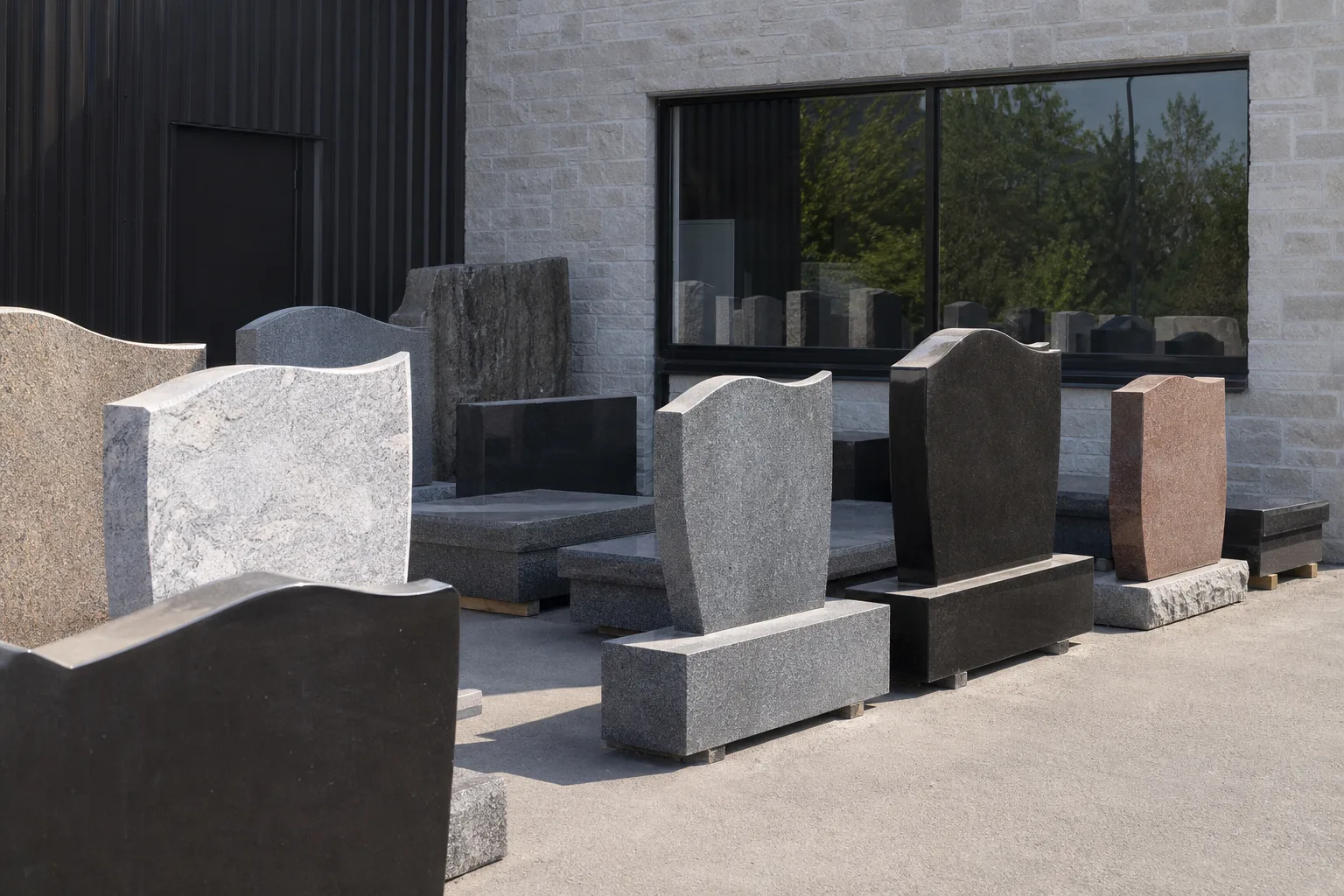
Ask for the second name panel to be shown filled with placeholder text at actual size rather than left blank. Spacing errors are almost invisible on a reduced drawing.
A woman in Scarborough ordered a flat granite companion marker eight weeks after her husband's burial, and the drawing that came back from the dealer showed exactly what she had asked for: two name panels, his on the left with birth and death years, hers on the right with a birth year and an empty space where the second date would go. She signed it. What she had not looked at closely was the width of the right-hand panel, which had been laid out for her maiden surname rather than her married one, and the difference was four characters and about an inch and a half of stone she would never get back.
1. The empty half is a decision, not a gap
Layout on a companion monument is fixed the day the first name is cut, because the letter height, the panel margins and the centering of the family surname are all set against the finished face. A careful reader asks the dealer to show the second panel filled in with placeholder text at full size, not left blank on the proof, so the spacing can be judged with the longest version of the name that might eventually appear there. Names change. Middle names get added, hyphenated surnames arrive through remarriage, and a nickname that seemed obvious in the first month can look wrong a decade later.
2. The second date is a separate job, priced separately
The closing date is almost always cut on site, at the grave, by a letterer working with portable equipment, and that work is a distinct contract from the monument itself. Two things are worth settling in writing at the time of the original order: whether the price for the later cut is locked or quoted at prevailing rates when the time comes, and whether any amount paid now is held as a deposit that survives a change of dealer. Cemetery access rules matter too, since frozen ground, section closures and equipment restrictions can push field lettering into a working window that is narrower than most families expect.
3. Lettering that does not use the Latin alphabet
Chinese, Korean, Greek, Cyrillic, Hebrew, Arabic and Armenian inscriptions are cut routinely across Ontario grounds, and the failure point is almost never the cutting. It is proofing. A dealer whose staff cannot read the script is checking shapes against a file, which catches nothing, so the family should insist that the proof be reviewed and signed by someone who reads the language, ideally a relative and a second person outside the family. Ask specifically how the characters were supplied: a typed font, a calligrapher's original, or a scan traced by hand. Each behaves differently at small letter heights and in shallow relief.
4. Symbols and portraits vary by section, not just by cemetery
Emblems, etched portraits and ceramic photographic medallions are governed by operator bylaws that can differ between a lawn section and a monument section within the same grounds, and the practical distinction is usually projection: anything standing proud of the face complicates mowing and gets restricted. Ceramic ovals are commonly permitted on upright stones and refused on flush markers. Laser etching of a photograph is generally treated as part of the stone rather than an attachment, which is why it clears review more often. Confirm the specific section, in writing, before the artwork is commissioned.
5. Who is allowed to change it later
Authority to alter an inscription follows the interment rights, not the person who paid the original invoice, and rights holders change through transfer, survivorship and estate administration more often than families anticipate. If three adult children hold rights jointly, the cemetery will usually want all three to authorize an addition, and one absent signature stops the work. Sorting the paperwork early, while everyone agrees, is cheap. The Federal Trade Commission, which oversees how funeral goods and services are priced and disclosed to consumers, is a useful reminder that itemized written terms are the norm to expect on any monument order.
The stone in Scarborough was recut, at the dealer's cost, because the error was on their drawing. That outcome depended entirely on the fact that she had kept the signed proof, dated, with the annotation she had made in the margin about the surname.